On this page 6 sections
Banner eyelets are the metal or plastic rings punched through a banner’s edge so you can tie it to railings, fences, frames or walls. They sit at each corner and at regular spacing along the edges, through a hemmed border for strength. Leave them off when a banner goes into a frame or is fixed with clips.
What eyelets do
An eyelet, also called a grommet, is a reinforced hole. Without one, a cable tie or rope pulled through the material would slowly tear its way out. The ring spreads the load around the hole, so the banner can be pulled tight without ripping.
On a PVC banner, eyelets go through the hemmed edge, where the material is folded back and welded into a double layer. The hem and eyelet together make the strongest fixing point on the banner. Our explainer on what a PVC banner is covers hemming and materials in more detail.
Plastic or metal
On our PVC banners you can choose plastic or metal eyelets.
| Eyelet | Strengths | Suits |
|---|---|---|
| Plastic | Light, will not rust, gentle on painted surfaces | Events, indoor banners, short-term use |
| Metal | Stiff, holds its shape through repeated fixing | Banners put up and taken down often, long-term outdoor use |
Standard spacing and corners
Every banner needs an eyelet at each corner. The corners take the most strain, and they set the shape of the banner when it is tied. Between the corners, eyelets are spaced along the edges so that the load is shared and the edge cannot sag or flap between fixings.
As a general guide, eyelets every half metre or so along each edge give a good balance between strength and appearance. On a 6ft x 3ft banner that means a row along the top and bottom and one or two on each short side.
Why spacing matters
Too few eyelets and the edge billows between fixings, the wind gets behind it, and the strain concentrates on the few ties there are. Too many on a small banner just adds holes. Standard spacing suits nearly every railing, fence and wall.
Extra eyelets for long banners
Long, shallow banners such as 4m x 1m, or banners that will face strong wind, benefit from closer spacing along the top and bottom. The extra fixing points spread the load further and stop the middle of the banner from bellying out.
- Long fences in open ground: tie every eyelet, top and bottom.
- Banners strung between two posts: the top edge takes most of the load, so make sure every top eyelet is tied.
- Mesh banners on Heras fencing: tie every eyelet even though mesh reduces wind load.
The general outdoor banners page shows eyelet and hemming options alongside every size, so you can see what is included before you order.
When a plain edge is better
Eyelets are not always wanted. A banner without eyelets leaves a clean edge for:
- Frames and sign systems that grip the banner edge or use a tension cord.
- Clip or clamp fixings on exhibition shells and wall rails.
- Pole pockets added separately, or banners hung from a batten.
- Display use where the banner is taped or framed and holes would show.
Banners without eyelets come in 440gsm PVC or 400gsm PVC-free, in eight metric sizes from 1.5m x 0.5m up to 4m x 1m.
Hemming without eyelets
On most of our PVC sizes you can choose hemmed edges or none, separately from the eyelet choice. A hem without eyelets gives a neat, strong edge for clamps; no hem gives the flattest edge for a frame.
Fixing through the eyelets
The eyelets are only as good as what goes through them. The right fixing depends on where the banner goes.
- Cable ties: quick, strong and easy to replace. Best for railings and fences. Our banners can be ordered with bags of ties.
- Bungee cords: allow a little give in wind, good for banners removed often.
- Rope or cord: for banners strung between posts or trees.
- Hooks and screws: for walls, through each eyelet into a plug or timber.
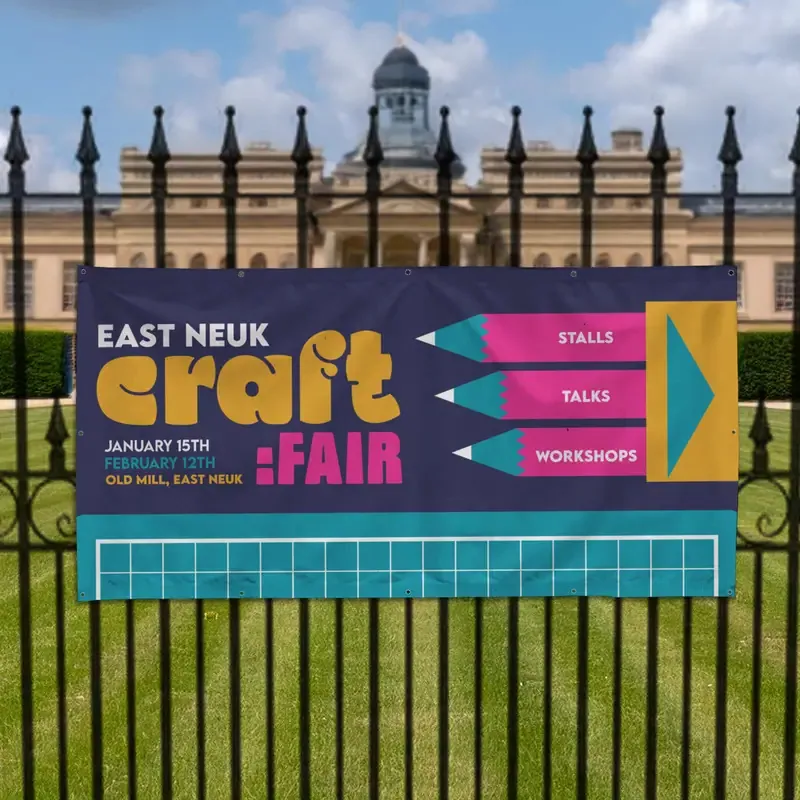
Fence banners are typically tied with cable ties through every eyelet. Pull each tie firm, starting at the top corners, and stand back to check the banner is level and taut.
Common mistakes
- Tying only the corners, which leaves the edges to flap and tear.
- Over-tightening one corner, which puts diagonal ripples across the print.
- Pulling ties off rather than snipping them, which stretches the eyelet.
- Using wire, which can cut through the hem.
A new shop or business taking over premises often orders its first banner with a takeover message; our post on the under new management banner shows how those are worded and hung. Eyelet and hemming choices are listed on every product in our PVC banners range, with prices shown live.
Questions
What are banner eyelets?
Plastic or metal rings punched through the edge of a banner so it can be tied with cable ties, rope or bungees without tearing.
How far apart should banner eyelets be?
Around every half metre along each edge is a good general spacing, with an eyelet at every corner. Long or exposed banners benefit from closer spacing.
Should I choose plastic or metal eyelets?
Both are strong. Metal holds its shape better if the banner is fitted and removed often; plastic is lighter and gentle on painted surfaces.
Can I order a banner without eyelets?
Yes. A banner without eyelets suits frames, clamp systems and pole pockets, and comes in eight metric sizes.
What is the best way to tie a banner through its eyelets?
Cable ties through every eyelet, starting at the top corners and pulling each one firm. Snip ties to remove the banner rather than pulling them.