On this page 8 sections
Often, yes. In the UK most outdoor banners count as advertisements, and many need advertisement consent from the council, though some, such as certain temporary notices for local events, have deemed consent within limits. You always need the landowner’s permission, and the highway authority’s for anything on lamp posts.
This guide is general information, not legal advice. Rules differ between England, Scotland, Wales and Northern Ireland, and between councils, so always check the details for your area.
Three kinds of permission
1. The landowner
Whatever the planning rules say, you need permission from whoever owns the fence, wall, building or land. That includes schools, churches, councils, landlords and farmers. A quick written yes avoids arguments later.
2. The planning authority
In England, outdoor advertising is controlled by the Town and Country Planning (Control of Advertisements) (England) Regulations. Scotland, Wales and Northern Ireland have their own equivalents. Under these rules, adverts fall into three broad groups:
- Excluded: a small number of advertisement types sit outside the controls altogether.
- Deemed consent: many common types are allowed without applying, provided they meet conditions on size, position, lighting and how long they stay up.
- Express consent: everything else needs an application to the council.
3. The highway authority
Banners on lamp posts, road signs, bridges or anything over a road or pavement are a highways matter. They usually need permission from the council’s highways team, and sometimes a licence. Putting banners on street furniture without permission can lead to them being removed.
Banners that often have deemed consent
The regulations include classes of deemed consent for some temporary advertisements. In broad terms, these can include notices for local non-commercial events such as church fetes, school fairs and charity fun runs, boards on construction sites, and certain signs on business premises, each with conditions. Conditions typically limit the size, the height, whether it can be lit, and how long before and after the event it can be displayed.
Because the details matter, read the government’s guide to outdoor advertisements and signs, or ask your council’s planning team, before relying on deemed consent.
Banners that are more likely to need consent
- Large banners on the side of a building facing a road.
- Commercial advertising on land that is not the business’s own premises.
- Banners displayed for long periods rather than for a short event.
- Anything in a conservation area, on a listed building or in a national park, where rules are stricter.
- Illuminated signs.
Practical checks before you put up a banner
- Ask the owner of the fence or building.
- Check the location: conservation area, listed building or national park.
- Check the type: event notice, site board, business sign or general advert.
- Check size and timing against the deemed consent conditions.
- Keep it safe: not blocking sight lines at junctions, not obscuring road signs, securely fixed.
- If in doubt, ask the council. Most planning teams will answer a quick question by email.
Safety matters too
Even with permission, a banner must not distract drivers or hide traffic signs, and it must be fixed so it cannot blow loose. On fences near roads, use every eyelet and choose mesh on exposed sites. Banners that are damaged or come loose should be taken down quickly.
Common situations
School or church event banner on its own railings
Usually straightforward: you own the railings, the event is local and non-commercial, and the banner is temporary. Check the size and timing conditions, and take it down after the event.
Construction site banner
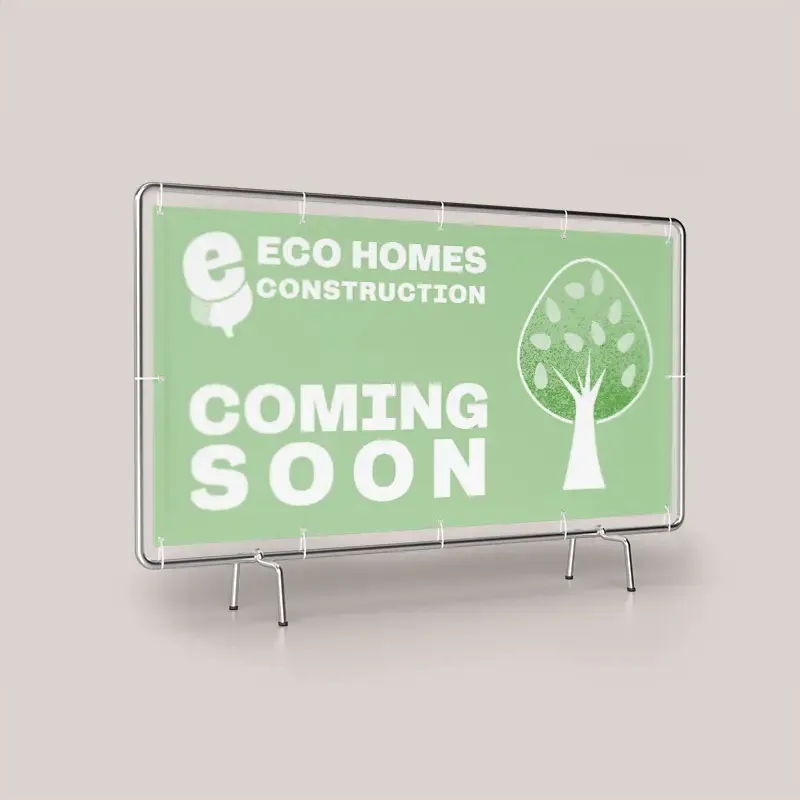
Site boards and hoarding graphics are common and some have deemed consent with conditions. Large wrap-around advertising on scaffolding is more likely to need consent. Our construction site banners are printed in mesh or PVC for site fences.
Shop or business banner
A banner on your own premises advertising your own business may fall within deemed consent, subject to conditions; a large banner elsewhere probably will not. Feather flags on your own forecourt are common, but check before placing feather flags on the pavement, which is public highway.
Banner on a farmer’s field by a main road
This needs the landowner’s permission and is likely to need advertisement consent if it is advertising something away from that land. It must also be safe for drivers.
Choosing a banner that keeps everyone happy
Smaller, well-fixed, temporary banners are least likely to cause problems. For events, an event banner put up shortly before and taken down promptly is the usual approach. For outdoor display of any kind, an outdoor banner with hemmed edges and metal eyelets stays tidy and secure, which councils and neighbours appreciate.
Questions
Do I need planning permission for a banner?
Many outdoor banners count as advertisements and need advertisement consent, though some temporary and event banners have deemed consent within limits. Check with your local council.
Can I put a banner on my own fence?
Usually yes for small, temporary banners such as event notices, but conditions apply and some areas have stricter rules. Large or long-term adverts may need consent.
Can I put a banner on a lamp post?
Not without permission from the highway authority, usually the council’s highways team. Unauthorised banners can be removed.
Do the rules differ across the UK?
Yes. England, Scotland, Wales and Northern Ireland each have their own advertisement regulations, and councils apply them locally.
What happens if I put up a banner without consent?
The council can ask for it to be removed, and continuing to display an advert without the required consent can be an offence. It is simpler to check first.