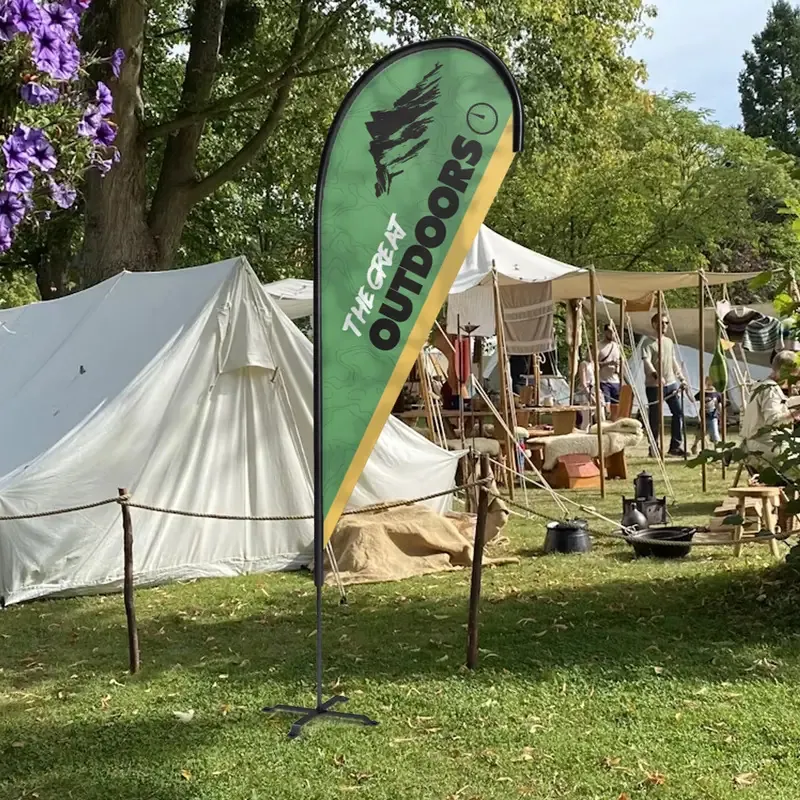
What is a teardrop flag? It is a printed fabric flag shaped like a teardrop, held taut on a curved, flexible pole that bends round the top and down one side. The shape keeps the design open and readable even in still air. Sizes run from 2.1m to 4.6m, on a spike or weighted base.
Shape
A teardrop flag has a rounded top that narrows towards the bottom, with the pole running up one edge and bending over the curve. Because the fabric is stretched on all sides by the bent pole, the flag stays open even when there is no wind. That makes the design readable all day, whether the air is still or breezy.
It is close to a feather flag but not the same. A feather flag is taller and narrower with one curved edge, and its free edge can fold over in a strong wind. A teardrop is shorter and wider for its height, with more space for a logo. Our comparison of the feather flag vs teardrop flag goes into the differences.
How it is put together
The kit is a printed fabric flag with a sleeve sewn along one edge, a pole that comes in sections, and a base or spike. You slot the pole sections together, slide the sleeve over the pole and hook the bottom of the flag to tension it, which pulls the pole into its curve. With a little practice it takes a few minutes.
Spinning in the wind
Most teardrop flag bases allow the pole to rotate, so the flag turns with the wind rather than fighting it. This reduces strain on the pole and base, and means the flag shows different faces as it turns, which catches attention.
Sizes
Teardrop flags come in four heights.
| Height | Where it suits |
|---|---|
| 2.1m | Indoors, shop doorways, small stalls |
| 2.8m | Pavements, cafe entrances, school events |
| 3.5m | Car parks, forecourts, showgrounds |
| 4.6m | Roadsides and large outdoor events |
The teardrop flag 2.8m is a popular all-round choice: it rises above people on a pavement and fits in a car. The teardrop flag 3.5m suits wider spaces where it needs to be seen from further away. The teardrop flag 4.6m is for roadsides and big events.
Single or double sided
A single-sided flag shows the design in mirror image from the back. If the flag will be seen from both sides, such as at an entrance or on a pavement, choose double sided so the text reads correctly from both directions.
Bases
The base must suit the ground. A flag on the wrong base will lean or fall.
- Ground spikes for grass, sand and soft ground: standard or budget.
- Cross bases for hard surfaces, usually with a water bag on top for weight.
- Water bases, small or large, filled on site and emptied to carry.
- Square or concrete bases for indoor use or long-term hard standing.
- Drive-on car bases that sit under a car tyre, popular on forecourts.
You can choose a base when you order the flag, or buy flag bases and ground spikes separately if you need different bases for different events.
Uses
Teardrop flags suit places where a business or event wants to be noticed from a short to medium distance, and where the logo matters.
- Shop and cafe doorways: a logo flag beside the entrance.
- Car dealers and garages: rows along the forecourt.
- Sports clubs: sponsor flags along the touchline.
- Events and shows: marking entrances, stands and meeting points.
- Estate agents: outside viewings and open houses.
- Beaches and watersports: on sand with a ground spike.
Designing for the shape
The wider top section is where the logo sits best. Text runs vertically down the length or in short stacked words. Keep content away from the pole sleeve and the narrow bottom, where it can be hidden. A logo with one or two words, such as the business name, works better than a sentence.
Choosing quantity
A single flag marks a door. Two flags frame an entrance. A row of matching flags along a forecourt or a touchline turns a space into an event. Ordering several flags with the same design lowers the price per flag, which is why car dealers and clubs often order in fives and tens.
Care
A teardrop flag lasts many outings with a little care.
- Bring it in during storms and very high winds.
- Take it in at night unless the area is secure.
- Let it dry before packing it into the bag.
- Check the pole sections for cracks before each use.
- Keep the base and spike clean of mud and sand.
Flags left out permanently fade and fray faster. Businesses that use flags every day often keep a spare to rotate. For the full set of feather and teardrop options, see our feather flag guide and all sizes and bases in our teardrop flags range, priced live.
Questions
What is a teardrop flag?
A printed fabric flag shaped like a teardrop, held open on a bent flexible pole so the design stays readable even without wind.
What sizes do teardrop flags come in?
2.1m, 2.8m, 3.5m and 4.6m. The 2.8m size is a good all-rounder for pavements and entrances.
Which base do I need for a teardrop flag?
A ground spike for grass or sand; a cross base with a water bag, a water base or a square base for hard surfaces; a drive-on base for forecourts.
Is a teardrop flag better than a feather flag?
A teardrop stays open in still air and has more room for a logo; a feather flag is taller and narrower. The best choice depends on the space and design.
Can teardrop flags be used indoors?
Yes. The 2.1m size on a square or cross base suits most indoor spaces.