On this page 12 sections
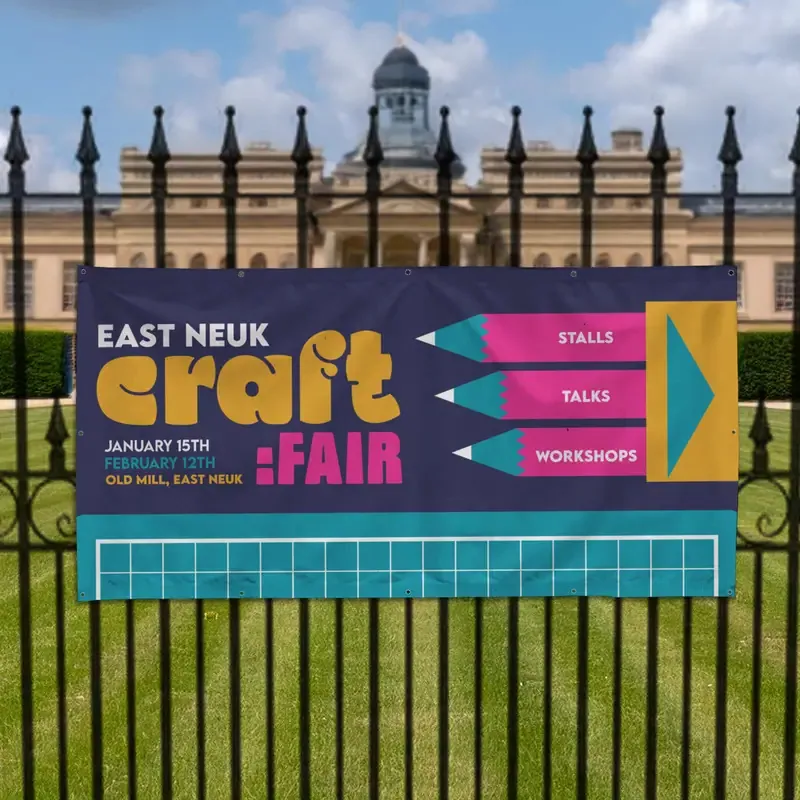
For most outdoor banners the best material is 440gsm PVC: waterproof, tough and bright, with hemmed edges and eyelets. On windy or exposed sites, 260gsm mesh is better because wind passes through it. To avoid PVC, choose 400gsm PVC-free, and for a soft textile look on fences, 105gsm fabric airmesh.
The four main options
| Material | What it is | Strengths | Best outdoor uses |
|---|---|---|---|
| 440gsm PVC | Solid, flexible vinyl sheet | Bright print, waterproof, durable | Railings, walls, shopfronts, events |
| 260gsm mesh | Perforated PVC mesh | Wind passes through, lighter | Heras fences, scaffolding, sports grounds |
| 400gsm PVC-free | Banner material made without PVC | Similar look to PVC, avoids PVC | Railings, walls and events where PVC is avoided |
| 105gsm airmesh | Lightweight woven fabric | Soft textile finish, light, breathable | Fences, barriers, event dressing |
The gsm figure is the weight in grams per square metre. Higher numbers mean a heavier, thicker material, which usually means more durable.
PVC: the everyday outdoor choice
A PVC banner is what most people mean when they say “vinyl banner” or “flex banner”. The print sits on a solid surface, so colours are strong and text is crisp even close up. It shrugs off rain and can be wiped clean. If your banner is going on a gate, railings, a wall or the front of a shop, and the site is reasonably sheltered, PVC is the right answer.
Mesh: for wind
Wind is what destroys outdoor banners, not rain. A solid banner on an exposed fence is pushed by every gust, which strains the eyelets and the fence. A mesh banner reduces that load. It looks like a normal banner from a few metres away, though it is partly see-through up close. On building sites, scaffolding and big fences it is standard practice.
PVC-free: avoiding PVC
Some organisations, such as councils, schools, charities and businesses with environmental policies, prefer not to use PVC. A PVC-free banner offers a similar finish and the same options for eyelets and hems, so it can replace a PVC banner in most outdoor uses.
Fabric airmesh: a textile look
Airmesh fabric banners are light and soft, with a woven feel. They breathe well in the wind and suit event fences, barriers and places where a fabric finish looks better than vinyl. Being lighter, they are easy to transport and put up in quantity.
Finishing matters as much as material
Hems
A hem is the edge of the banner folded back and sealed. It strengthens the edge so eyelets do not tear out. For outdoor use, hemmed edges are strongly recommended.
Eyelets
Eyelets are the rings punched along the edges for fixing. Metal eyelets are stronger and suit long-term or exposed outdoor use. Plastic eyelets are lighter and fine for sheltered or short-term displays.
Cable ties
The simplest way to fix any outdoor banner to railings or fencing. You can add bags of ties to your order.
Choosing by location
- School or church railings in a street: PVC, hemmed, metal eyelets.
- Shopfront fascia or wall: PVC.
- Construction site Heras fence: mesh.
- Scaffold wrap or building face: mesh.
- Sports ground perimeter: mesh or airmesh.
- Seaside or hilltop event: mesh.
- Council or school with a no-PVC policy: PVC-free.
Indoor versus outdoor
Some banners spend their whole life inside, in a sports hall, a church or an office. For those, weather resistance matters less than how the print looks close up and whether the material hangs flat. Our indoor banners are made for exactly that, with print that holds up when read from a few steps away. If a banner will move between indoors and outdoors, for example at events, stick with PVC or PVC-free with metal eyelets, so it can cope with both.
Colour outdoors
Sunlight is hard on any print over long periods. Strong, saturated colours and dark text on light backgrounds stay readable for longer than pale tints. If a banner will be up for many months in full sun, plan to replace it when it starts to look tired rather than expecting it to stay as bright as the day it went up.
How long does an outdoor banner last
There is no single answer, because it depends on the weather, the fixings and how much the banner moves. A well-fixed banner on a sheltered wall can last for years. The same banner left loose on an exposed fence can wear out in a single windy season. To get the most life from any material:
- Fix through every eyelet, not just the corners.
- Keep it tight so it does not flap.
- Take it in during storms if you can.
- Store it rolled, clean and dry between uses.
Artwork for outdoor banners
Outdoor banners are read from further away, so use bold type, high contrast and few words. Photos need around 100 to 150 dpi at full size. On mesh, avoid very fine lines and small text. Before anything prints, one of our team looks over your file. To see all sizes and options in one place, visit our outdoor banners page.
Questions
What is the best material for an outdoor banner?
For most uses, 440gsm PVC with hemmed edges and eyelets. On windy or exposed sites, 260gsm mesh is better.
What is a PVC flex banner?
Flex banner is another name for a flexible PVC banner, the solid vinyl material used for most outdoor banners.
Are PVC banners waterproof?
Yes. PVC does not absorb water and can be wiped clean, which is why it is the standard outdoor banner material.
Is there an alternative to PVC banners?
Yes. PVC-free banners offer a similar finish without PVC, and fabric airmesh is a light textile option for fences and barriers.
Are metal or plastic eyelets better outdoors?
Metal eyelets are stronger and suit long-term or exposed displays. Plastic eyelets are fine for sheltered or short-term use.