On this page 7 sections
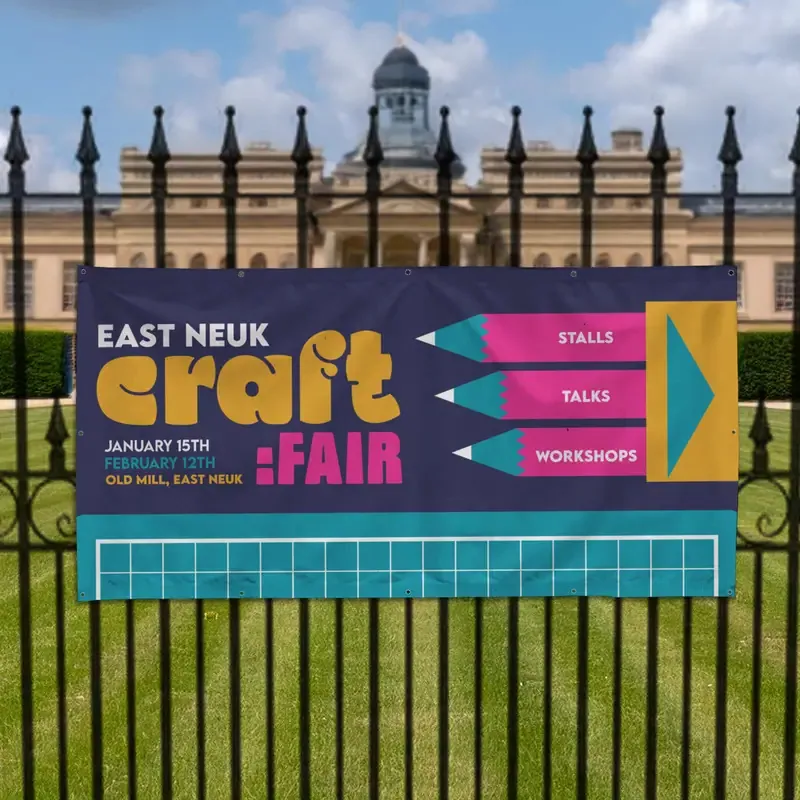
What is a PVC banner? It is a flexible sheet of polyester scrim coated in PVC, printed in full colour and finished with hemmed edges and eyelets so it can be tied to railings, fences or walls. It is the standard outdoor banner: waterproof, tough, easy to fix and sold in many standard sizes.
What a PVC banner is made of
A PVC banner has two layers working together. In the middle is a woven polyester mesh, called the scrim, which gives the sheet its strength and stops it stretching. Around it is a coating of PVC, which makes the surface smooth, waterproof and ready to take ink. The result looks like a thick, slightly glossy sheet, a bit like a heavy tarpaulin but with a print surface made for colour.
Because the scrim runs through the whole sheet, a PVC banner does not tear easily at the edges, and eyelets punched through it hold firm under tension.
Material weight and what it changes
Banner material is described by weight in grams per square metre. Our standard PVC banners are printed on 440gsm PVC, a weight that suits most outdoor jobs: heavy enough to hang flat and survive weather, light enough to fold and post.
| Material | What it is | Best for |
|---|---|---|
| 440gsm PVC | Solid, waterproof PVC banner | Railings, walls, shop fronts, events |
| 400gsm PVC-free | A PVC-free banner with a matt look | Indoor walls, receptions, schools |
| 260gsm mesh | Perforated, lets wind through | Fences, scaffolding, exposed sites |
If you are unsure which material suits your spot, our guide to the best material for outdoor banners walks through exposure, wind and lifespan. For a full comparison with mesh, read PVC vs mesh banners. The short version: solid PVC gives the brightest print and suits sheltered or medium-exposure spots, while mesh is the safer choice on a long fence in open country.
Hemmed edges and eyelets
Finishing is what turns a printed sheet into a banner you can hang. Two options matter most.
Hemming
A hem folds the edge of the banner back on itself and welds it, making a double-thickness border. It stiffens the edge, helps the banner hang straight and gives the eyelets more material to grip. You can choose hemmed edges or none on our PVC sizes.
Eyelets
Eyelets are the rings punched through the border so you can thread cable ties, bungees or rope. You can choose plastic or metal eyelets. Eyelets usually sit at each corner and then at regular intervals along the edges, so the load is shared rather than resting on four points. If the banner is going into a frame or being fixed with clips, the banner without eyelets leaves the edge plain.
Cable ties can be added to the order by the bag, which saves a trip to the hardware shop on the day.
Plastic or metal
Plastic eyelets are light and do not mark a painted wall if the banner rubs against it. Metal eyelets are stiffer and hold their shape when a banner is fitted and removed many times, which suits shops and clubs that reuse the same banner every season. Either works for a single event or a few months on a railing.
Indoor and outdoor use
PVC is built for outdoors, but it works inside too. Outside, it shrugs off rain and can be wiped clean. Inside, it hangs flat on a hall wall or behind a stage, though the slight sheen can catch spotlights.
For outside use, an outdoor banner on 440gsm PVC is the default. For inside use where glare matters, an indoor banner on 400gsm PVC-free material has a flatter, matt look that photographs well.
The print itself is full colour across the whole sheet, so photos, gradients and brand colours all reproduce. Large flat areas of a single strong colour, such as a red background, look especially bold on PVC.
Wind is the main enemy
A solid banner behaves like a sail. On a long fence in an open field it can catch enough wind to pull eyelets or bend the fence. Tie it at every eyelet, keep it tight, and switch to mesh if the site is very exposed.
How long a PVC banner lasts
A PVC banner tied tightly in a sensible spot can last for many months outdoors, and an indoor banner can be reused for years. What shortens its life is movement: a banner that flaps against a fence rubs and stretches at the eyelets until they tear out.
- Tie every eyelet, not only the corners.
- Take banners down before storms where you can.
- Roll rather than fold for storage, with the print facing out.
- Store dry. A banner rolled while wet can mark.
Picking a size
Start with the space, then the reading distance. A 6ft x 3ft PVC banner is the most popular choice for railings, gates and party walls, because it fits most spaces and reads clearly across a street. Larger fences and building fronts suit 8ft x 4ft, 3m x 1m or 3m x 2m.
All standard sizes are listed in the PVC banners range, with prices that update live as you change size and quantity. Upload your artwork when you order; every file goes through an automatic check for resolution and size before it is printed.
Questions
What is a PVC banner made of?
A woven polyester scrim coated on both sides with PVC. The scrim gives strength and the coating makes it waterproof and printable.
Is a PVC banner waterproof?
Yes. The PVC surface does not absorb water, so the banner can stay outside in rain. Dry it before rolling it up for storage.
What does 440gsm mean?
It is the weight of the material in grams per square metre. 440gsm is a sturdy weight that hangs flat and copes with outdoor use.
Can a PVC banner be used indoors?
Yes. It hangs well on walls and behind stages. If glare from lighting is a concern, a PVC-free indoor banner has a flatter finish.
Do I need hemmed edges?
Hemming is recommended for outdoor banners because it strengthens the border and helps eyelets hold. A banner going into a frame may not need it.